If decoupling technology suppresses noise from "within the power supply," shielding technology blocks noise propagation from the "external environment." The two complement each other, forming the twin pillars of PCB noise reduction. In high-speed, RF (Radio Frequency), and high-EMI-sensitive scenarios (such as wireless communications, medical devices, and industrial controls), relying solely on decoupling is often insufficient to meet noise reduction requirements. It is essential to isolate noise sources from sensitive circuits and block external interference through shielding technology. However, many engineers blindly apply standard solutions when designing shields, ignoring the underlying principles and scenario adaptation, which leads to inadequate shielding effectiveness or even introduces new resonant interference.
The essence of shielding is to form a closed "Faraday cage" using conductive or magnetic materials, blocking the spatial propagation of electromagnetic energy through mechanisms such as reflection, absorption, and eddy current cancellation. Depending on the type of noise (electric fields, magnetic fields, electromagnetic radiation), shielding principles are divided into three categories, corresponding to different material selections and design strategies.
1. Electric Field Shielding (High-Frequency Electric Field Interference)
Core Mechanism: Reflection + Ground Dissipation.
Principle: When a high-frequency electric field (e.g., from high-speed signal lines or RF modules) encounters a good conductor (copper, aluminum, tin-plated steel), most of the energy is reflected. The remaining energy induces charges on the conductor surface, which are rapidly dissipated to the ground plane via grounding, thereby preventing the electric field from propagating inward.
Design Strategy: This requires high material conductivity but low thickness (≥0.1mm is sufficient). It is suitable for high-frequency, low-intensity electric field interference scenarios.
2. Magnetic Field Shielding (Low-Frequency Strong Magnetic Field Interference)
Core Mechanism: Eddy Current Cancellation + Magnetic Shunting.
Principle: Low-frequency magnetic fields (50Hz power frequency, motor magnetic fields) possess strong penetration capabilities, making reflection and absorption by good conductors ineffective. High-permeability materials (Permalloy, silicon steel sheets) must be used. On one hand, the changing magnetic field induces eddy currents in the shield; these currents generate a reverse magnetic field that cancels out the original field. On the other hand, high-permeability materials provide a low-reluctance path for magnetic flux lines, causing them to "detour" within the shield and protecting the internal circuitry.
Design Strategy: This requires high material permeability and sufficient thickness (≥0.5mm). It is suitable for low-frequency, high-intensity magnetic field interference scenarios.
3. Electromagnetic Radiation Shielding (High-Frequency Electromagnetic Wave Interference)
Core Mechanism: Reflection + Absorption + Multiple Attenuation.
Principle: High-frequency electromagnetic waves (GHz-level radiation, space wireless signals) contain both electric and magnetic components, requiring the shield to block both. The surface impedance of a good conductor shield is much lower than the wave impedance of air, reflecting most of the wave. The residual wave is attenuated by converting to thermal energy via eddy current losses as it propagates inside the shield. After multiple reflections and absorptions, the leakage energy is minimal.
Design Strategy: This requires a balance between conductivity and thickness. For high frequencies, thin and highly conductive materials are preferred; for low frequencies, increased thickness or high-permeability materials are necessary.
Core PCB-Level Shielding Schemes
PCB shielding solutions are primarily categorized into Metal Shielding Cans, Via Fences, and Stack-up Shielding. These correspond to module-level, local isolation, and global shielding scenarios, respectively.
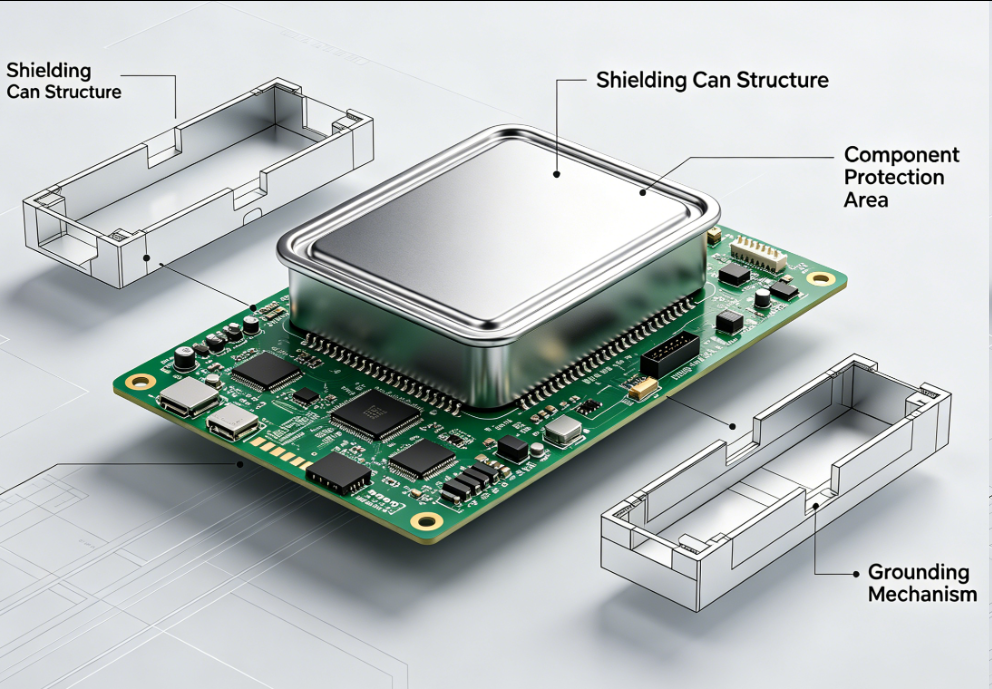
1. Metal Shielding Can (Module-Level Shielding, Most Common)
Used for strong noise sources or highly sensitive modules such as RF modules, clock oscillators, and high-speed interfaces. It is the mainstream solution for PCB shielding.
Materials: Tin-plated steel (cost-effective, good performance), copper alloys (excellent high-frequency performance), or aluminum (lightweight). Thickness: 0.2~0.5mm.
Structure: Use a "shield frame + cover" fixed via SMT soldering to ensure a 360° fully enclosed structure with no gaps.
Grounding Design (Critical):
Route continuous annular ground copper traces (width ≥1mm) beneath the shield frame, free of solder mask (green oil).
Connect to the main ground plane using dense grounded via arrays (spacing ≤ λ/20, where λ is the wavelength of the highest interference frequency, typically 2~3mm) to ensure multi-point, low-impedance grounding.
Aperture Control:
Cavity Resonance Suppression: Avoid cavity heights at λ/2 or λ/4 resonance points. Avoid 1:1 aspect ratios. Add internal partition ribs for large cavities.
2. Via Fence (Local Isolation, Cost-Effective)
Used for local isolation of sensitive traces or small components within the PCB. It does not require additional cans, offering low cost and flexible layout.
Design Points:
Place two staggered rows of ground vias around the isolation area (e.g., analog sections, clock lines) to form a "via fence."
Via spacing must be strictly ≤ λ/20; row spacing ≥ 1mm. Staggered arrangement blocks direct leakage paths.
Vias must connect to all ground layers to ensure vertical grounding continuity.
Surface copper in the via area must be grounded, with no signal lines crossing over, forming a closed ground isolation belt.
3. Stack-up Shielding (Global Shielding, Multilayer Boards)
Applicable to 4-layer or higher multilayer boards. It utilizes internal power/ground planes for global shielding without occupying top-layer space, offering stable effectiveness.
Design Points:
Adopt a layer stack-up like "Signal - Ground - Power - Ground" or "Ground - Signal - Ground," sandwiching sensitive signal layers between two ground planes to block vertical interference.
Keep the spacing between power and ground planes ≤ 4 mils to form a low-impedance power supply and a natural shield.
Route ground copper rings on the surface layer and connect them to all ground layers via plated through-holes to form a PCB edge "Faraday cage" boundary.
Strictly prohibit signal lines from crossing ground plane splits to avoid broken return paths and degraded shielding effectiveness.
Scenario Adaptation & Troubleshooting
Scenario | Recommended Solution | Key Design Parameters |
|---|
RF / High-Speed | Metal Can + Stack-up Shielding | Via spacing ≤ 2mm; avoid cavity resonant frequencies. |
Analog / Digital Mixed | Via Fence + Single-Point Grounding | Via wall spacing ≤ 3mm; isolate analog and digital grounds. |
Industrial / Automotive | High-Permeability Can + Thick Copper Ground | Enhance low-frequency magnetic field shielding capability. |
Common Issues & Solutions
Conclusion
PCB shielding technology is a systematic design process characterized by "layered principles, adapted schemes, and attention to detail." Only by selecting the corresponding shielding mechanism based on the noise type (electric/magnetic/electromagnetic radiation), choosing the appropriate scheme (metal can, via fence, or stack-up shielding) based on the scenario, and strictly controlling key details such as grounding, apertures, and resonance suppression, can an efficient and stable shielding system be constructed to completely block the spatial propagation paths of noise.




 Home >


