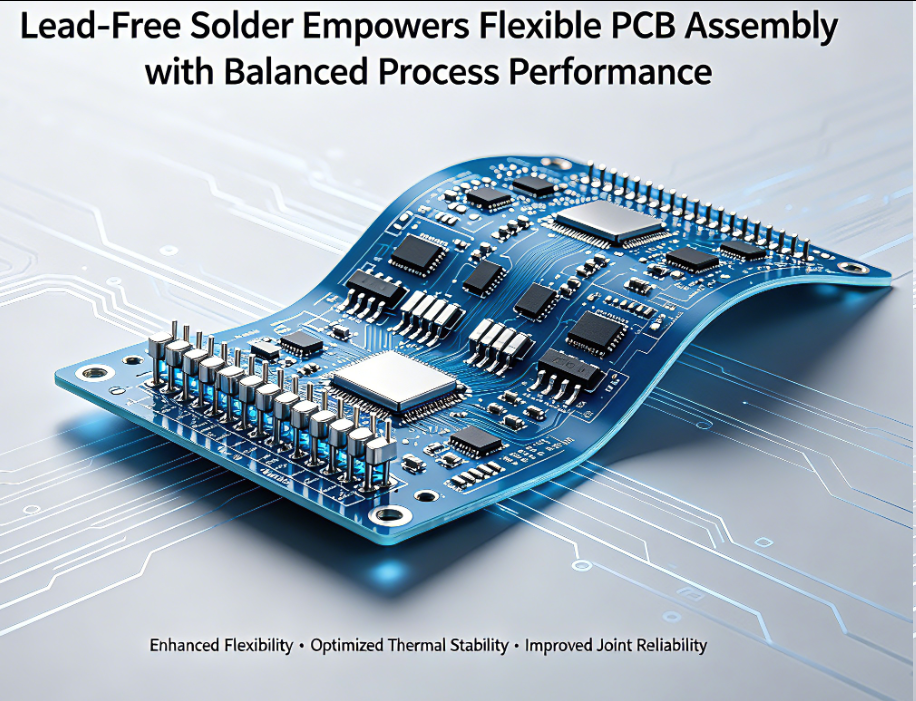
Flexible PCBs (FPC), characterized by their lightness, thinness, bendability, deformation resistance, and high spatial adaptability, are now widely used in wearables, smart terminals, automotive electronics, medical instruments, and industrial flexible sensor modules. With tightening global environmental regulations in electronics manufacturing and the deepening of green production concepts, traditional lead-based solders are gradually receding from mainstream applications, making lead-free solder the core material choice for flexible PCB assembly. Many industry professionals perceive lead-free transition as merely a means to meet environmental compliance; however, this is not the case. Given the unique material structure, bending conditions, and assembly processes of flexible PCBs, lead-free solder not only aligns with sustainable development goals but also demonstrates comprehensive advantages in mechanical properties, long-term reliability, and process compatibility—achieving a dual unification of environmental protection and product quality.
The substrates of flexible PCBs are primarily polymer flexible materials such as polyimide (PI) and polyester film, which feature high toughness and stringent anti-bending requirements. Their solder joints must endure repeated deformation alongside the board, imposing demands on ductility and bond strength far higher than those for rigid PCBs. Traditional lead-based solder has a relatively low melting point and a softer texture, making it acceptable for short-term soldering effects. However, lead reduces the overall structural strength of the solder alloy. Under the frequent bending and twisting conditions of flexible boards, lead-containing solder joints are highly prone to micro-cracks, delamination, or even fractures, directly leading to circuit disconnection. In contrast, mainstream lead-free solders—primarily tin-copper (Sn-Cu) and tin-silver-copper (SAC) alloys—offer superior tensile strength and fatigue resistance thanks to optimized alloy ratios. Lead-free solders possess a denser crystalline structure, ensuring uniform internal stress distribution after joint formation. When an FPC undergoes bending, folding, or stretching, the solder joints can absorb the impact of deformation, significantly reducing the probability of fatigue failure. In products requiring tens of thousands of bends, such as wearables and foldable screen terminals, the service life of lead-free solder joints is markedly improved, securing the long-term operational stability of flexible electronics at the assembly source.
From the perspective of sustainable development and eco-environmental protection, this is the core underlying logic for replacing lead-based solder. Lead is a typical toxic heavy metal characterized by high toxicity, non-degradability, and easy bioaccumulation. Throughout the lifecycle of a flexible PCB—from production and assembly to use and recycling—lead-containing solder joints pose multiple environmental risks. During production, lead dust in solder fumes and waste residues contaminates workshop air and wastewater, endangering workers' health. During product use, damaged boards or high-temperature aging present a risk of trace lead leaching. When flexible electronic products reach their end-of-life, improper disposal of large volumes of e-waste allows lead to seep into soil and water sources, causing long-term ecological pollution. Currently, many countries have enacted environmental directives such as RoHS and WEEE, strictly limiting the use of hazardous substances like lead in electronic products. Lead-free solder completely eliminates lead components from its formulation; its welding byproducts and waste slag contain no toxic heavy metals. This makes the entire process—from production emissions and solid waste treatment to e-waste recycling—easier to align with environmental standards, perfectly fitting the trend of green transformation in electronics manufacturing and paving the way for a circular development path for the flexible PCB industry.
Regarding assembly process compatibility, lead-free solder has undergone years of iterative improvements and is now fully compatible with mainstream flexible PCB welding processes. A major challenge in assembly is that flexible PCBs are heat-sensitive and prone to thermal deformation. Early lead-free solders were questioned for potentially damaging flexible substrates due to their higher melting points. Today, this issue has been thoroughly resolved through alloy optimization, upgraded flux formulations, and refined temperature zone profiling. Mainstream SAC lead-free solders, paired with specialized low-temperature fluxes and segmented heating profiles, ensure excellent wettability—allowing the solder to fully adhere to copper pads and component leads to form full, bright joints—while keeping the thermal impact on polyimide substrates within a reasonable range, thus avoiding defects like blistering, warping, and substrate aging. Simultaneously, lead-free solder exhibits stronger oxidation resistance. In mass production lines, the solder bath surface oxidizes slowly, generating less dross. This not only reduces material consumption but also lowers assembly defects caused by oxide slag, such as cold solder joints, false welding, and bridging, effectively boosting the yield rate of flexible PCBs.
In the stages of rework and recycling, the advantages of lead-free solder are equally prominent. Flexible PCBs often require frequent rework during R&D prototyping and small-batch trial production. Lead-free solder maintains stable alloy composition, with minimal degradation in fluidity and wettability upon remelting. During rework, issues like solder embrittlement or cracking do not occur, allowing for multiple cycles of disassembly and re-soldering without damaging the flexible pads. From a resource circulation perspective, lead-free solder alloys have a singular composition with fewer impurities, making the refining and regeneration of scrap solder joints and dross easier and more efficient. For high-volume flexible PCB manufacturers, solder recycling and reuse can effectively reduce raw material costs, forming a closed-loop model of "production-recycling-reuse" that further strengthens industrial sustainability.
For flexible PCB assembly, lead-free solder is by no means a simple eco-friendly substitute. It utilizes superior mechanical fatigue resistance to adapt to the deformation conditions of flexible boards, employs non-toxic formulations to meet global environmental compliance, leverages mature and stable process characteristics to suit mass assembly and rework operations, and assists the industry in achieving resource circularity. As the flexible electronics industry continues to expand, choosing lead-free solder is both an inevitable choice to comply with regulations and environmental trends, and a critical measure to enhance product reliability and consolidate the foundation for the industry's long-term development.




 Home >


