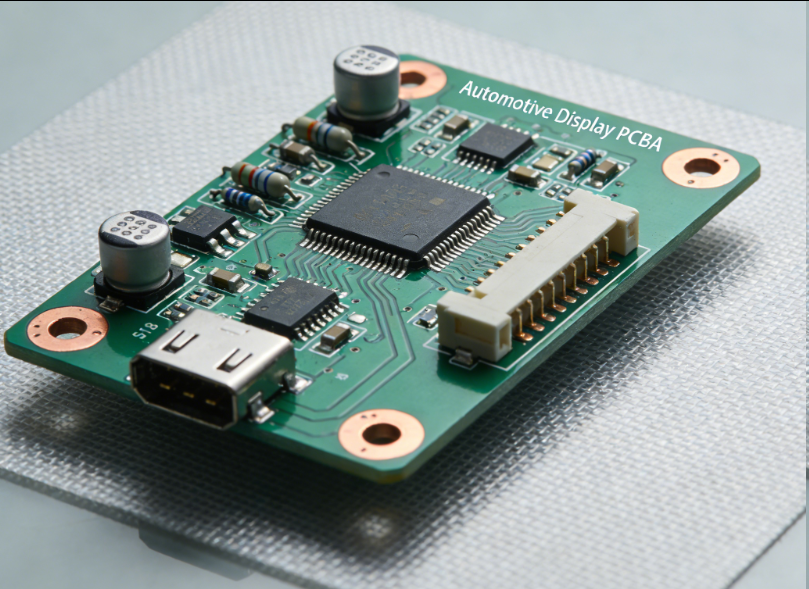
Automotive Display PCBA is the core component that powers the digital interface of modern vehicles, serving as the "nerve center" connecting the vehicle’s sensors, ECU (Electronic Control Unit), and display modules such as instrument clusters, central control screens, and HUD (Head-Up Display) systems. Unlike consumer electronics PCBA, it must meet strict automotive-grade standards to withstand harsh in-vehicle environments, including extreme temperature fluctuations, continuous vibration, and complex electromagnetic interference (EMI) from engine systems, radars, and charging equipment. Typically designed with 4 to 10 layers, this PCBA integrates high-performance microcontrollers, display drivers, and signal processing chips to ensure fast response, high-resolution output, and stable data transmission.
In electric and hybrid vehicles, Automotive Display PCBA plays an even more critical role by displaying real-time data such as battery life, charging power, and motor speed, while supporting multi-screen linkage and AR-HUD interaction in high-end smart cockpits. It adopts high-Tg FR-4 substrates (Tg≥170℃) to resist high-temperature oxidation and low-temperature brittleness, and uses shielding designs and impedance matching to avoid display glitches or data jumps caused by EMI. With the trend of intelligent and connected vehicles, this PCBA is evolving to integrate 5G, Bluetooth, and AI processing capabilities, providing drivers and passengers with a seamless, safe, and interactive in-vehicle experience. Its reliability directly determines the accuracy of vehicle information display and the overall user experience, making it an indispensable part of modern automotive design.




 Home >


