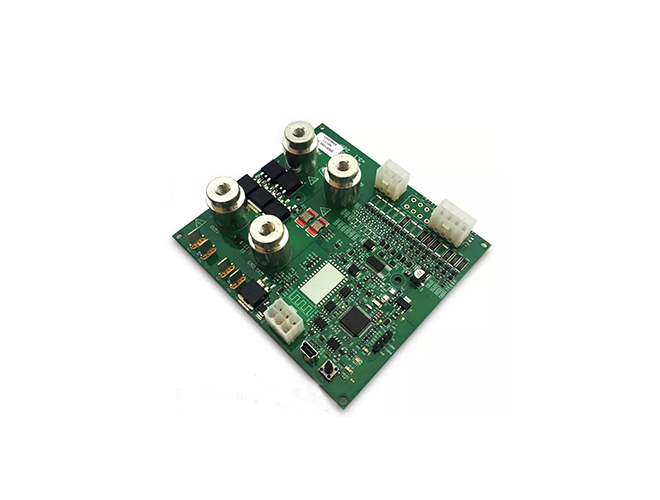
Robot sensor networks rely on high-frequency PCB systems to realize real-time collection, transmission and fusion of multi-dimensional sensing data, including visual, radar, ultrasonic and inertial sensing signals. Unlike conventional low-frequency PCBs, high-frequency PCBs for robot sensors need to maintain ultra-stable signal transmission performance under GHz-level operating frequencies, which is the core guarantee for robot environmental perception and autonomous decision-making. The primary performance requirement is low signal loss characteristics, covering dielectric loss and conductor loss. The PCB substrate must adopt low Dk (dielectric constant) and low Df (dissipation factor) materials with stable frequency characteristics, effectively reducing signal attenuation and phase distortion during high-speed transmission. Meanwhile, precise impedance control is mandatory, with standard impedance values of 50Ω for single-ended signals and 100Ω for differential pairs, to eliminate signal reflection and crosstalk caused by impedance mismatch.
Electromagnetic interference (EMI) suppression and signal integrity maintenance are key high-frequency indicators for robot sensor network PCBs. Robots have complex internal electromagnetic environments, with servo motors, power switching modules and communication modules generating strong electromagnetic noise during operation. High-frequency PCBs need to adopt multi-layer board design with complete ground and power plane isolation, matched with differential pair routing, dense grounding vias and shielded wiring structures. This structural design can effectively isolate external electromagnetic interference and prevent high-frequency sensor signal leakage, ensuring the accuracy of low-amplitude sensing data. In addition, the PCB layout must follow high-speed wiring specifications, controlling trace width, spacing and length consistency to avoid timing delay differences in multi-channel sensor synchronous transmission, which is critical for multi-sensor fusion positioning and obstacle avoidance functions of robots.
Environmental stability and long-term reliability are indispensable high-frequency performance requirements for robot sensor PCBs. Robot working scenarios involve frequent vibration, temperature fluctuation and dynamic load changes, which easily cause high-frequency parameter drift of PCBs. Qualified high-frequency sensor PCBs need to maintain stable dielectric properties and impedance characteristics in the temperature range of -40℃ to 85℃, without obvious performance attenuation under continuous vibration and impact. Moreover, the PCB surface treatment and copper foil materials need high oxidation resistance and structural stability to avoid increased conductor loss caused by copper foil oxidation and line aging during long-term high-frequency operation. These performance indicators jointly ensure the continuous and stable operation of robot sensor networks in complex industrial and service scenarios.




 Home >


