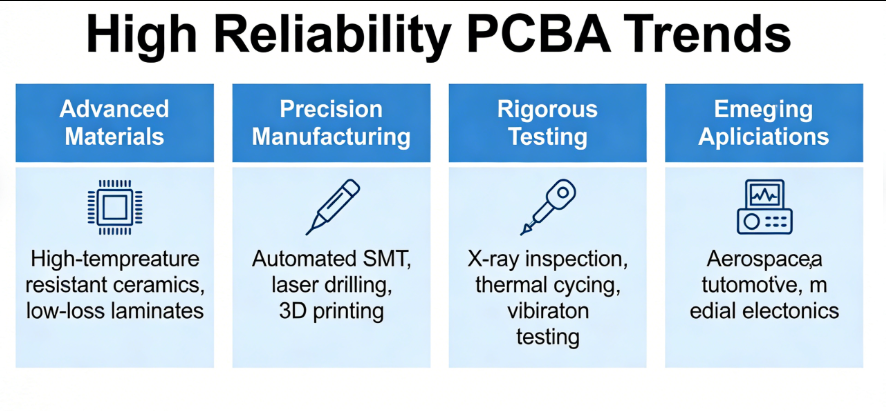
Driven by the rapid iteration of high-end electronic products such as medical devices, automotive electronics, and new energy storage systems, the trend of high reliability in PCBA (Printed Circuit Board Assembly) has become increasingly prominent, becoming a core requirement for industrial upgrading. As revealed at CES 2026, the electronics manufacturing industry is shifting from pursuing low cost and large batches to focusing on quality stability, compliance, and long-term durability, which directly promotes the continuous evolution of high-reliability PCBA technologies.
In specific applications, medical electronic PCBA must meet strict compliance and traceability requirements, such as ISO 13485 certification and full-process data recording, to ensure stability in clinical use. Automotive electronic PCBA faces harsh environmental challenges, requiring compliance with AEC-Q series standards and passing temperature cycle tests of -40℃ to 125℃ to adapt to the centralized domain controller architecture. For new energy storage systems, PCBA needs to have three-proof (moisture-proof, mildew-proof, salt-fog-proof) performance and an MTBF of more than 150,000 hours to ensure long-term stable operation in complex environments. Additionally, supply chain localization and flexible manufacturing capabilities have become important supports for improving PCBA reliability, helping enterprises reduce supply chain risks and respond quickly to market changes.
With the support of policies such as China’s "Three-Year Action Plan for the High-Quality Development of the Electronic Information Manufacturing Industry (2025–2027)" and the EU’s RoHS 3.0 directive, high-reliability PCBA will further develop towards miniaturization, high integration, and full-life-cycle management, becoming a key driving force for the high-quality development of the electronics industry.




 Home >


