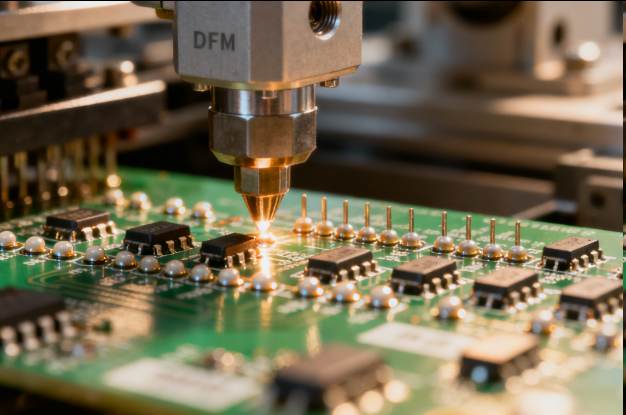
Manufacturability-Oriented PCBA Design (also known as Design for
Manufacturability, DFM) is a design approach that optimizes printed circuit
board assemblies to align with mass production processes, minimizing
manufacturing defects, reducing assembly time, and ensuring consistency across
large production runs. Unlike design focused solely on functionality, DFM
prioritizes compatibility with automated assembly equipment (e.g.,
pick-and-place machines, reflow ovens) and standard manufacturing
practices—critical for lowering production costs and accelerating time-to-market
in industries like consumer electronics, automotive, and IoT.
The core of DFM lies in adhering to manufacturing constraints and
simplifying assembly steps. Key technical considerations include: 1) Component
Selection for Manufacturability: Choosing components with standard, widely
available footprints (e.g., 0402, 0603 for passives) instead of custom or
obsolete packages, which are harder to source and handle. Surface-mount
technology (SMT) components are preferred over through-hole (THT) where
possible, as SMT is faster to assemble and compatible with automated
pick-and-place. For THT components (e.g., connectors), ensuring they have
sufficient lead length (3-5mm) for wave soldering and are placed on one side of
the board to avoid flipping the PCB during assembly. 2) PCB Layout for Assembly:
Maintaining minimum component spacing (e.g., ≥0.1mm between components, ≥0.2mm
from component to board edge) to prevent pick-and-place errors and ensure proper
solder joint formation. Designing clear, non-overlapping solder masks (with
opening size 1.2x the pad size) to protect traces and ensure accurate soldering.
Adding fiducial marks (2-3 per board, typically 1mm diameter) on the PCB—these
are used by pick-and-place machines to calibrate component placement, reducing
alignment errors. 3) Solder Joint Reliability: Ensuring pad sizes match
component leads (e.g., pad width 1.1x lead width for resistors) to prevent
insufficient or excessive solder, which can cause joint failure. Avoiding
“tombstoning” (a defect where passive components stand upright) by balancing pad
sizes for 0402 and smaller components and placing them parallel to the direction
of reflow oven conveyor movement. 4) Panelization Design: Grouping multiple PCBs
into a single panel (panelization) to optimize material usage and speed up
assembly. Including breakaway tabs (with V-scores or mousebites) between PCBs
for easy separation post-assembly, and ensuring panel edges have tooling holes
(3-4mm diameter) for handling by manufacturing equipment.
DFM implementation requires collaboration with manufacturing teams early in
the design process. Engineers use DFM analysis tools (e.g., Mentor Graphics DFM
Checker, Altium DFM Analyzer) to automatically check the design against 100+
manufacturing rules (e.g., component spacing, pad size, solder mask coverage)
and flag issues like insufficient clearance or non-standard footprints. Physical
prototyping with a small batch (10-20 units) is critical to validate
manufacturability—testing assembly efficiency, identifying defects, and refining
the design before mass production.
Application scenarios highlight DFM’s impact. In consumer electronics
(e.g., smartphone PCBs), DFM ensures 0201-sized passives are placed accurately
by pick-and-place machines, reducing defect rates to <0.1%. In automotive
PCBs (e.g., ADAS modules), DFM optimizes solder joint design to withstand
vibration and temperature cycles, ensuring long-term reliability. In high-volume
IoT devices (e.g., smart bulbs), DFM panelization reduces material waste by
15-20% and cuts assembly time per unit by 30%. With manufacturing defects
accounting for up to 40% of product failures, DFM is essential for delivering
cost-effective, reliable PCBs at scale.




 Home >


