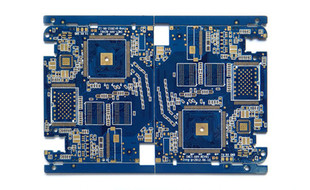
PCB sensor components are at the forefront of modern electronics, enabling devices to detect and respond to various physical and environmental parameters. These sensors are integrated onto PCBs to convert real - world phenomena such as temperature, pressure, light, motion, and humidity into electrical signals that can be processed by the circuit.
Temperature sensors are among the most commonly used PCB sensor components. They can be based on different principles, such as thermocouples, resistance temperature detectors (RTDs), or thermistors. Thermocouples generate a small voltage that is proportional to the temperature difference between two junctions, while RTDs and thermistors change their electrical resistance with temperature. In PCB - based systems, temperature sensors are used for thermal management, ensuring that components do not overheat. For example, in computer motherboards, temperature sensors monitor the CPU and GPU temperatures, triggering fans to increase their speed when necessary.
Pressure sensors, on the other hand, are used to measure mechanical pressure. MEMS (Micro - Electro - Mechanical Systems) - based pressure sensors are popular in PCB applications due to their small size, high accuracy, and low power consumption. These sensors are widely used in automotive tire pressure monitoring systems, medical devices for measuring blood pressure, and industrial process control for monitoring fluid pressure.
Light sensors, such as photodiodes and phototransistors, detect the intensity of light. They are used in applications like automatic - dimming displays, ambient light - sensing for energy - saving purposes, and optical communication systems. Motion sensors, including accelerometers and gyroscopes, are essential in devices such as smartphones, gaming controllers, and drones, enabling functions like gesture recognition, orientation sensing, and motion tracking.
The integration of sensor components onto PCBs requires careful consideration of factors such as sensor accuracy, sensitivity, and compatibility with other components on the board. Signal conditioning circuits are often incorporated near the sensors to amplify, filter, and convert the raw sensor signals into a suitable format for further processing. As the Internet of Things (IoT) continues to grow, the demand for PCB sensor components will increase, driving innovation in sensor design and integration to enable more intelligent and responsive electronic systems.
PCB Optocoupler Devices
Optocoupler devices, also known as optoisolators, are key components in printed circuit boards that provide electrical isolation between two circuits by using light as a medium for signal transmission. This unique functionality makes them highly valuable in a wide range of applications where electrical isolation is crucial for safety, noise reduction, and circuit protection.
An optocoupler typically consists of an input side with a light - emitting diode (LED) and an output side with a light - sensitive device, such as a phototransistor or a photodiode. When an electrical current is applied to the LED on the input side, it emits light. This light is then detected by the light - sensitive device on the output side, which converts the light signal back into an electrical signal. Since there is no direct electrical connection between the input and output sides, optocouplers effectively isolate the two circuits, preventing the transfer of electrical noise, ground loops, and electrical surges.
In power supply circuits, optocouplers are used to isolate the high - voltage primary side from the low - voltage secondary side. This isolation ensures the safety of users and protects sensitive components on the secondary side from electrical hazards. In data communication systems, optocouplers are employed to prevent electrical interference from degrading the quality of the transmitted signals. They are also used in industrial control systems to isolate control circuits from high - power electrical circuits, protecting the control system from electrical transients and improving the overall reliability of the system.
The performance of optocoupler devices in PCB applications depends on several factors, including the speed of signal transmission, the isolation voltage rating, and the coupling efficiency between the LED and the light - sensitive device. Different types of optocouplers, such as transistor - output, triac - output, and logic - output optocouplers, are available to meet the specific requirements of various applications. When integrating optocouplers into PCBs, designers must consider factors such as the layout of the input and output circuits, the placement of the optocoupler to minimize signal interference, and the power supply requirements for both the input and output sides. As electronic systems become more complex and the need for electrical isolation increases, PCB optocoupler devices will continue to play a vital role in ensuring the reliable and safe operation of these systems.




 Home >


