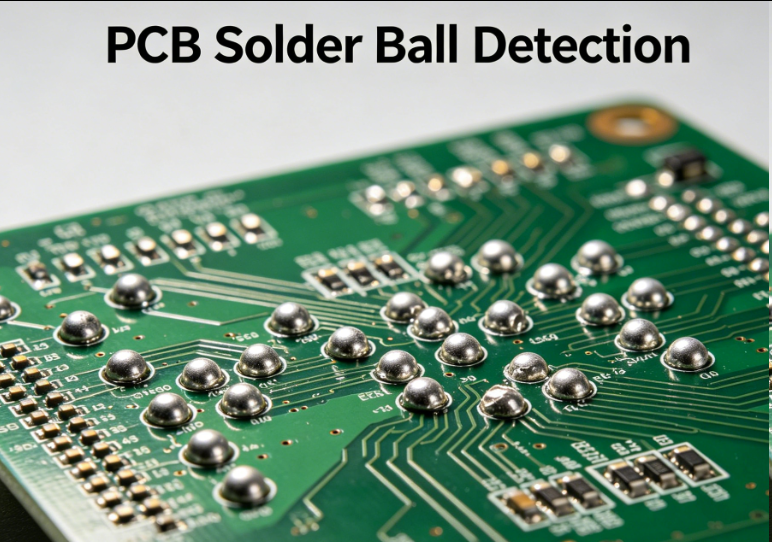
PCB solder ball detection is a specialized aspect of soldering quality control that focuses on identifying and evaluating solder balls—small, spherical particles of solder that form on the PCB surface during the soldering process. While small solder balls may seem insignificant, they pose significant risks to PCB performance and reliability, as they can cause short circuits between adjacent traces or components, especially in high-density PCBs with fine-pitch components. Solder ball detection is therefore critical for ensuring the safety and functionality of electronic devices, particularly in applications such as automotive electronics, medical devices, and aerospace systems, where reliability is paramount.
Solder balls are typically formed due to several factors, including improper solder paste application, incorrect reflow soldering parameters, poor stencil design, and contamination. Improper solder paste application, such as excessive solder paste or uneven application, can lead to solder splattering during reflow, forming solder balls. Incorrect reflow parameters, such as a too-fast heating rate (exceeding 3℃/s) or improper peak temperature, can cause the solder paste to melt and splatter, resulting in solder ball formation. Poor stencil design, such as incorrect stencil thickness or opening size, can lead to uneven solder paste deposition, increasing the likelihood of solder balls. Contamination, such as flux residues, dust, or metallic particles on the PCB surface, can also cause solder balls to form by providing nucleation sites for solder deposition. According to industry standards such as IPC-A-610, solder balls with a diameter greater than 0.13mm or located within 0.13mm of adjacent traces or components are considered defective and require remediation.
Solder ball detection methods vary depending on the size of the solder balls, the density of the PCB, and the production volume. Visual inspection is the most basic method, using magnifying glasses or stereo microscopes to detect visible solder balls on the PCB surface. However, manual visual inspection is prone to human error, especially for small solder balls (less than 0.1mm in diameter) or in high-density areas with fine-pitch components. Automated optical inspection (AOI) systems are therefore widely used for solder ball detection, as they can detect even microscopic solder balls with high accuracy and efficiency. AOI systems use high-resolution cameras and advanced image-processing algorithms to capture images of the PCB surface, compare them to a reference image, and identify any solder balls that exceed the acceptable size or are located in critical areas. For hidden solder balls, such as those under components or between PCB layers, X-ray inspection (AXI) is used. AXI systems use X-ray radiation to penetrate the PCB and components, revealing hidden solder balls that cannot be detected by visual or AOI inspection. This is particularly useful for BGA (Ball Grid Array) components, where solder balls are located under the component package.
Once solder balls are detected, it is essential to determine their root cause and implement corrective actions to prevent recurrence. This may involve adjusting reflow soldering parameters, optimizing stencil design, improving solder paste application processes, or enhancing PCB cleaning procedures to reduce contamination. For example, controlling the reflow heating rate to 1-2℃/s, optimizing stencil opening size to ensure proper solder paste deposition, and implementing thorough PCB cleaning after soldering can significantly reduce solder ball formation. Regular monitoring and testing of the soldering process, combined with effective solder ball detection methods, ensure that PCBs are free from harmful solder balls and meet the required quality and reliability standards.




 Home >


