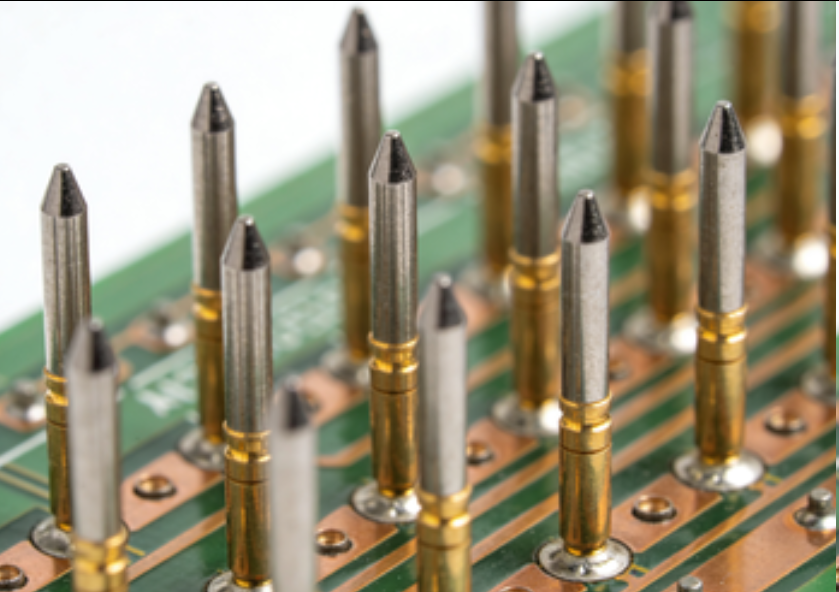
PCB Test Pins are specialized electrical connectors designed to facilitate the testing and validation of printed circuit boards (PCBs) during manufacturing, assembly, and quality control processes. These pins serve as temporary, high-precision contact points that establish electrical connections between the PCB’s test points (e.g., pads, vias, or component leads) and testing equipment—such as multimeters, oscilloscopes, or automated test equipment (ATE). Unlike permanent PCB components, test pins are engineered for repeated use, ensuring reliable signal transmission and accurate measurement of electrical parameters (e.g., voltage, current, resistance, and signal integrity) to identify defects like short circuits, open circuits, or faulty components. Their design is tailored to meet the demands of high-volume PCB production, where speed, precision, and durability are critical to maintaining quality standards and reducing production costs.
One of the primary functions of PCB Test Pins is to enable non-destructive testing (NDT) of PCBs, which is essential for preserving the integrity of the board and its components. Traditional testing methods that involve soldering temporary wires to test points can damage the PCB’s surface or components, especially for delicate PCBs used in electronics like smartphones or medical devices. PCB Test Pins, by contrast, use a spring-loaded or retractable design that makes gentle yet firm contact with the PCB’s test points—applying just enough pressure to ensure a low-resistance connection without scratching or deforming the board. For example, in the testing of a PCB for a wearable fitness tracker, tiny PCB Test Pins (as small as 0.2 mm in diameter) can access test points located between densely packed components (like microchips and sensors) without damaging nearby parts. This non-destructive approach allows manufacturers to test every PCB in a production run, ensuring that only functional boards move to the next assembly stage.
Precision and compatibility with diverse PCB designs are key features of PCB Test Pins. These pins are available in a wide range of sizes, shapes, and configurations to match the varying test point layouts of different PCBs. For instance, PCBs used in industrial control systems may have large, spaced-apart test pads (2 mm or more in diameter), requiring longer, sturdier test pins with a flat contact tip. In contrast, PCBs for consumer electronics (like laptops) often have tiny test vias (0.5 mm or smaller), which demand ultra-fine test pins with a sharp, needle-like tip to penetrate solder mask and make contact with the via’s conductive surface. Additionally, PCB Test Pins can be customized to support different electrical requirements: high-current test pins (capable of handling 10+ amps) are used to test power PCBs, while high-frequency test pins (optimized for signals up to 50 GHz) are designed for PCBs in communication devices (e.g., 5G routers). This versatility ensures that PCB Test Pins can adapt to the unique needs of almost any PCB application.
Durability and repeatability are also critical attributes of PCB Test Pins, as they are used repeatedly across thousands of test cycles in high-volume production. These pins are constructed from high-quality materials to withstand wear and tear: the contact tip is typically made from brass or copper (plated with gold, nickel, or rhodium to enhance conductivity and corrosion resistance), while the body and spring (in spring-loaded designs) are made from stainless steel or beryllium copper for long-term elasticity. For example, a gold-plated PCB Test Pin can withstand 100,000+ test cycles without significant loss of conductivity, making it suitable for large-scale production runs of PCBs (e.g., 100,000+ units for a popular smartphone model). The spring-loaded mechanism also ensures consistent contact pressure across each test cycle, reducing the risk of intermittent connections that could lead to false test results (e.g., incorrectly labeling a functional PCB as defective).
Integration with automated testing systems further enhances the value of PCB Test Pins. In modern PCB manufacturing, most testing is performed by ATE systems, which use arrays of PCB Test Pins mounted on test fixtures to simultaneously test multiple PCBs or multiple test points on a single PCB. These automated systems can complete a full test (including checking for short circuits, measuring component values, and verifying signal paths) in a matter of seconds—far faster than manual testing. For example, an ATE system for automotive PCBs may use a fixture with 50+ PCB Test Pins to test a control module’s power supply, communication ports, and sensor inputs in less than 10 seconds. This speed not only increases production efficiency but also ensures consistency in testing, as automated systems eliminate human error (e.g., misplacing a test probe or misreading a measurement). Whether it’s ensuring the reliability of medical device PCBs, validating the performance of automotive electronics, or streamlining the production of consumer gadgets, PCB Test Pins are indispensable for maintaining the quality and functionality of modern PCBs.




 Home >


