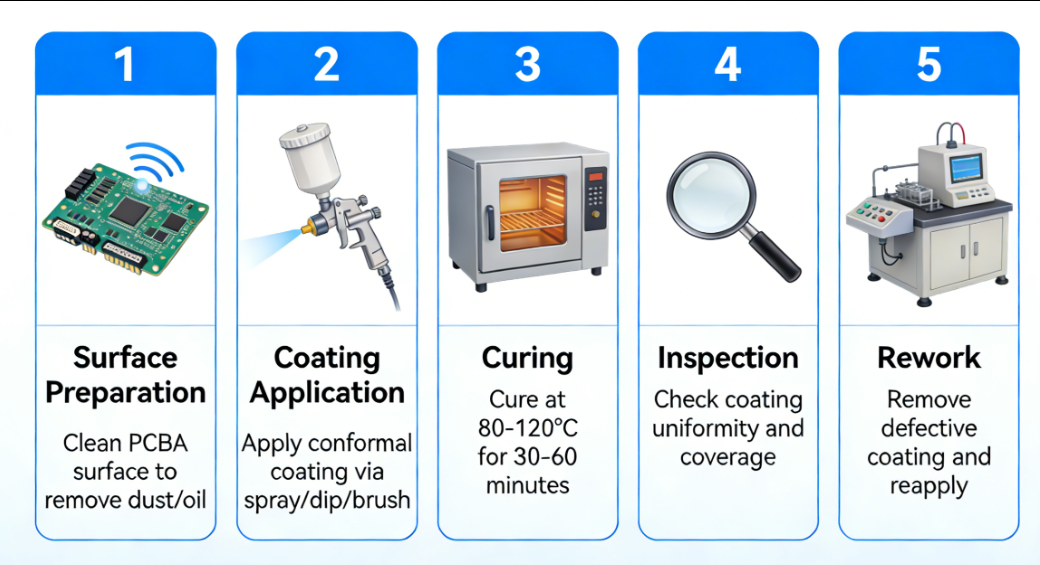
PCBA conformal coating is a thin, protective layer applied to the surface of printed circuit boards to shield them from environmental factors such as moisture, dust, chemicals, and temperature extremes. This coating plays a critical role in enhancing the reliability and lifespan of PCBA products, especially those used in harsh environments such as industrial, automotive, marine, and aerospace applications. The conformal coating application process involves several key steps, including surface preparation, masking, coating application, curing, and inspection, each of which must be executed with precision to ensure optimal protection and performance.
Surface preparation is the first and most critical step in the conformal coating process, as the coating’s adhesion and effectiveness depend on the cleanliness of the PCBA surface. Before applying the coating, the PCBA must be thoroughly cleaned to remove flux residues, solder particles, dust, and other contaminants. Common cleaning methods include ultrasonic cleaning (using isopropyl alcohol or aqueous cleaners at 60°C for 15 minutes), plasma cleaning (using an argon-hydrogen mix for 90 seconds to increase surface energy), and air drying (hot air convection at 80°C for 30 minutes to ensure humidity is below 30% RH). Any remaining contaminants can cause bubbles, poor adhesion, or premature coating failure, so thorough cleaning is essential.
Masking is the next step, which involves covering areas of the PCBA that should not be coated, such as connectors, test points, gold fingers, and components that are sensitive to the coating material. Common masking materials include polyimide tape (Kapton tape) for broad areas, masking boots for standard components, and temporary solder mask for uneven surfaces or custom areas. It is important to select masking materials that are compatible with the coating solvent to avoid adhesion issues or coating dewetting. After masking, the coating is applied using one of several methods, including spray coating, dip coating, brush coating, or robotic selective coating. Spray coating is the most common method for high-volume production, offering uniform coverage and high throughput (up to 120 boards per hour), while robotic selective coating is ideal for complex PCBs with delicate components, providing precision coverage (±5 μm) for specific areas.
Curing is the final step in the conformal coating process, where the coating is hardened to form a durable, protective barrier. The curing method depends on the type of coating material: acrylic coatings often use UV curing (365 nm wavelength, 2000 mJ/cm² energy for less than 5% voids), epoxy coatings use thermal curing (ramp rate 2°C/min to 120°C for 2 hours), and silicone coatings can be cured at room temperature or with heat. After curing, the PCBA undergoes inspection to ensure the coating is uniform, free of defects (bubbles, cracks, or missed areas), and adheres properly. Inspection methods include visual inspection, AOI, and adhesion testing (using tape to check for coating peeling). Proper execution of each step ensures that the conformal coating provides effective protection, enhancing the PCBA’s resistance to environmental stress and extending its service life.



 Home >


