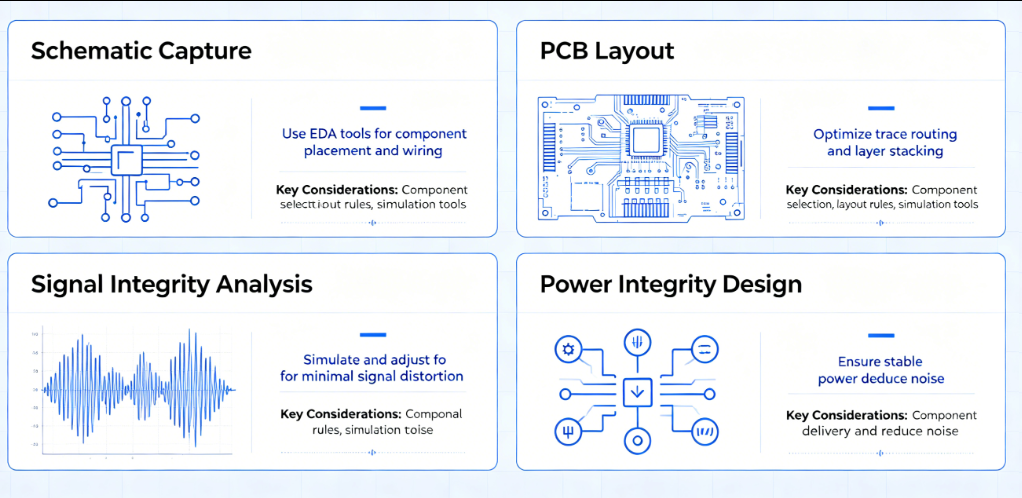
Digital circuit design is a core component of PCBA (Printed Circuit Board Assembly) development, focusing on the reliable transmission of binary signals (0s and 1s) and the stable operation of digital components such as microprocessors, logic gates, flip-flops, and memory chips. The key to successful digital circuit design lies in minimizing signal integrity issues, optimizing power distribution, and ensuring compatibility between components, all of which directly affect the performance, reliability, and manufacturability of the final PCBA. One fundamental technique is proper component placement, which should follow the principle of grouping related components (e.g., microcontroller, clock oscillator, and decoupling capacitors) to shorten signal paths and reduce electromagnetic interference (EMI). For example, clock signals—being high-frequency and prone to EMI—should be routed close to the ground plane and away from sensitive analog components, while decoupling capacitors (0.1μF and 10μF) should be placed as close as possible to the power pins of digital ICs to filter out power supply noise and stabilize voltage levels.
Another critical technique in digital PCBA design is signal routing. High-speed digital signals (e.g., those above 100 MHz) are susceptible to reflection, crosstalk, and delay, which can distort signals and lead to system failure. To mitigate these issues, designers should use controlled impedance routing (typically 50Ω or 75Ω, depending on the signal standard) and maintain consistent trace widths and spacing. Differential pairs—commonly used in interfaces like USB, HDMI, and Ethernet—require strict length matching (within 5-10 mils) and equal spacing to ensure balanced signal transmission and reduce common-mode noise. Additionally, avoiding right-angle bends in signal traces (using 45-degree bends or rounded corners) minimizes impedance discontinuities and signal reflection. Ground plane design is also essential: a solid ground plane not only provides a low-impedance return path for digital signals but also acts as a shield against EMI, reducing crosstalk between adjacent traces.
Design for Manufacturability (DFM) is another key consideration in digital PCBA design. This involves ensuring that the design is compatible with standard manufacturing processes, such as surface mount technology (SMT) and through-hole technology (THT). For example, component footprints must adhere to industry standards (e.g., IPC-7351) to ensure proper soldering, while trace widths and spacing should meet the minimum requirements of the manufacturing process (typically 6-8 mils for traces and 6 mils for spacing for standard SMT). Furthermore, incorporating test points at critical signal nodes and power supply lines allows for easy testing and debugging during production, reducing the risk of defective PCBs. Finally, simulation tools (e.g., SPICE, Altium Designer, or Cadence) should be used to validate the design before prototyping, simulating signal integrity, power distribution, and EMI performance to identify and resolve potential issues early in the design process.




 Home >


