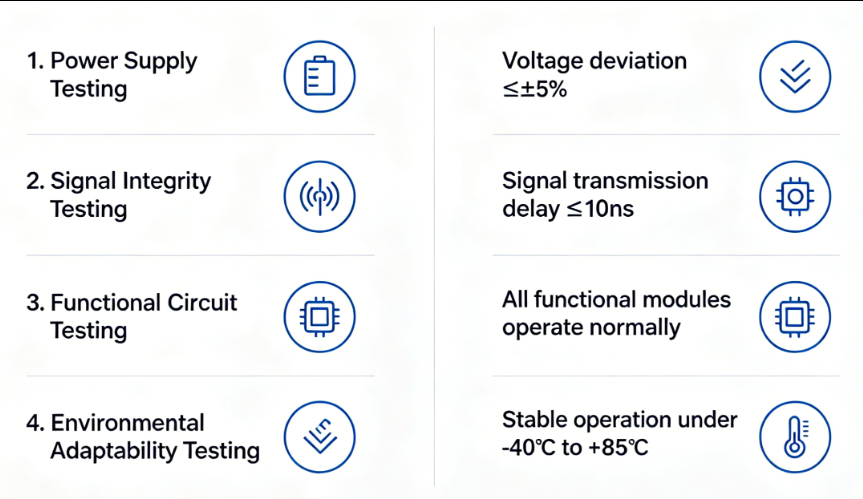
PCBA functional testing is a critical quality control step that verifies whether the assembled printed circuit board assembly (PCBA) performs its intended electrical and functional operations according to the design specifications. Unlike online testing (which focuses on assembly defects), functional testing evaluates the overall performance of the PCBA as a complete unit, simulating real-world operating conditions. The goal of functional testing is to ensure that the PCBA meets all functional requirements, works reliably, and is free from functional defects that could affect the performance of the final product. The specific functional testing items and standards vary depending on the PCBA’s design, application, and industry, but there are common testing items and universal standards that apply to most PCBAs.
One of the core functional testing items is power supply testing, which verifies the PCBA’s ability to operate correctly under specified power supply conditions. This includes testing the input voltage range, output voltage stability, current consumption, and power efficiency. For example, if a PCBA is designed to operate with a 5V DC input, the test will verify that the PCBA functions properly when the input voltage is within the specified range (e.g., 4.5V to 5.5V) and that the output voltage (if applicable) remains stable under different load conditions. The standard for power supply testing typically follows industry standards such as IEC 60601 (for medical devices), IEC 61010 (for electrical equipment), or manufacturer-specific specifications. The test may also include checking for power supply ripple and noise, which can affect the performance of sensitive components such as ICs, and verifying that the PCBA does not draw excessive current (which could indicate a short circuit or defective component).
Signal integrity testing is another important functional testing item, particularly for PCBAs used in high-speed applications (e.g., communication devices, computers, industrial control systems). Signal integrity testing evaluates the quality of electrical signals transmitted through the PCB’s traces, ensuring that signals are transmitted accurately and without distortion. Common tests include measuring signal rise time, fall time, jitter, skew, and eye diagram analysis. Rise time and fall time measure how quickly a signal transitions from low to high or high to low, which is critical for high-speed signals to avoid timing errors. Jitter refers to the variation in signal timing, which can cause data errors in digital circuits. Eye diagram analysis is used to visualize the quality of digital signals, with a clear "eye" indicating good signal integrity. The standards for signal integrity testing often reference industry standards such as IEEE 802.3 (for Ethernet) or PCI Express (for high-speed interfaces), and the test results must meet the design specifications for the PCBA’s intended application.
I/O (Input/Output) interface testing is essential for PCBAs that interact with external devices (e.g., sensors, displays, keyboards, communication modules). This testing verifies that all input and output ports on the PCBA function correctly, including data transmission, signal reception, and compatibility with external devices. For example, if a PCBA has a USB interface, the test will verify that the PCBA can communicate with a USB device, transfer data at the specified speed, and provide the correct power to the device. If the PCBA has a serial port (e.g., UART, RS-232), the test will check the accuracy of data transmission and reception, including baud rate, parity, and stop bits. The standards for I/O interface testing depend on the type of interface, with common standards including USB-IF (for USB interfaces), RS-232 (for serial ports), and HDMI (for video interfaces). The test must ensure that the PCBA’s I/O ports meet the electrical and functional requirements of the interface standard.
Functional performance testing is a comprehensive test that evaluates the PCBA’s overall performance under real-world operating conditions. This includes testing the PCBA’s ability to perform its intended functions (e.g., processing data, controlling a device, measuring a signal) accurately and reliably. For example, a PCBA used in a temperature sensor module would be tested to verify that it can accurately measure temperature within the specified range, convert the measurement to a digital signal, and transmit the signal to a controller. A PCBA used in a power management system would be tested to verify that it can regulate voltage, protect against overcurrent or overvoltage, and switch between different power modes. The standards for functional performance testing are typically based on the PCBA’s design specifications and the requirements of the end product. For example, medical PCBAs must meet strict standards such as ISO 13485, while industrial PCBAs may need to comply with IEC 61508 (functional safety). Additionally, functional testing may include environmental testing (e.g., temperature, humidity) to ensure that the PCBA performs reliably under different operating conditions.




 Home >


