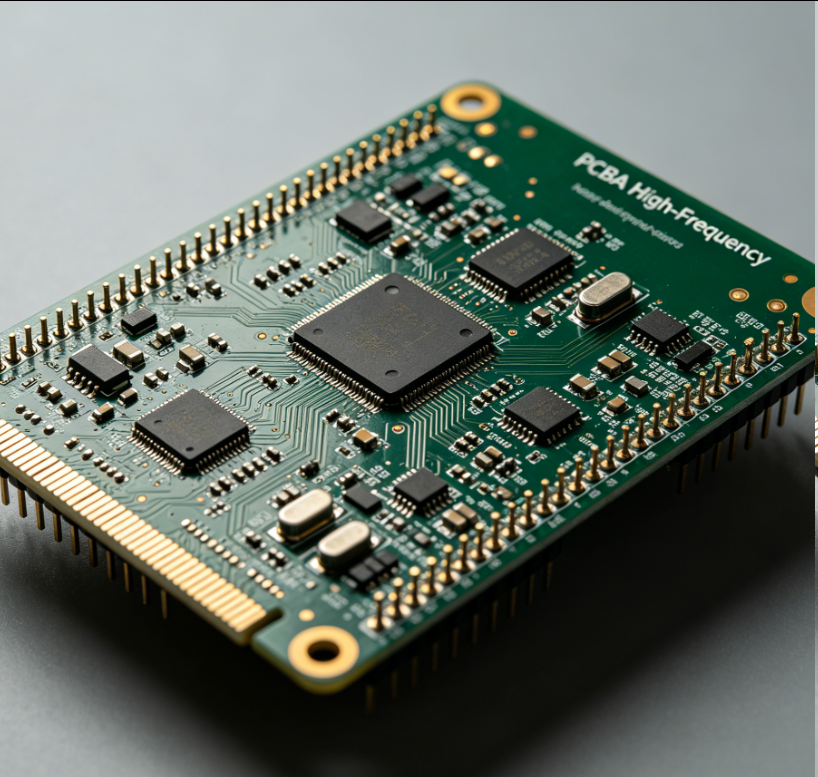
High-frequency PCBA design (typically defined as frequencies above 100 MHz) presents unique challenges due to the increased impact of parasitic effects, signal integrity issues, and electromagnetic interference (EMI). Unlike low-frequency designs, where signal propagation can be treated as instantaneous, high-frequency signals behave as electromagnetic waves, leading to phenomena such as transmission line effects, crosstalk, and impedance mismatch. To ensure the reliability and performance of high-frequency PCBs, engineers must carefully consider several key factors during the design phase, including transmission line design, component placement, grounding, and shielding.
Transmission line design is paramount in high-frequency PCBA design, as improper line impedance can cause signal reflections, attenuation, and distortion. The characteristic impedance of transmission lines (such as microstrip, stripline, and coplanar waveguide) must be matched to the source and load impedance (typically 50 ohms or 75 ohms for most high-frequency applications) to minimize signal reflections. Engineers must calculate the width of the transmission line based on the PCB substrate thickness, dielectric constant (εr), and copper thickness, using tools such as impedance calculators. Additionally, transmission lines should be kept as short and straight as possible to reduce signal delay and attenuation, and any bends should be gradual (with a radius of at least three times the line width) to avoid impedance discontinuities. Stubs (unused segments of transmission lines) should be minimized or eliminated, as they can act as antennas and cause signal reflections.
Component placement and routing are also critical in high-frequency design. High-frequency components (such as oscillators, amplifiers, and RF transceivers) should be placed close to each other to minimize the length of high-speed signal paths, reducing crosstalk and signal degradation. Sensitive components (such as receivers) should be separated from noise-generating components (such as power amplifiers or switching regulators) to avoid EMI. Routing high-frequency signals requires maintaining consistent impedance, avoiding parallel runs (which increase crosstalk), and using ground planes as reference planes to provide a low-impedance return path. Grounding is another key consideration: a solid ground plane (preferably a full ground layer) helps reduce ground bounce and EMI, while separate ground planes for analog and digital circuits (with a single point of connection) can minimize interference between different signal types. Finally, shielding (such as metal enclosures or shield cans) can be used to contain EMI and protect sensitive high-frequency signals from external interference, ensuring the PCB meets electromagnetic compatibility (EMC) standards.




 Home >


