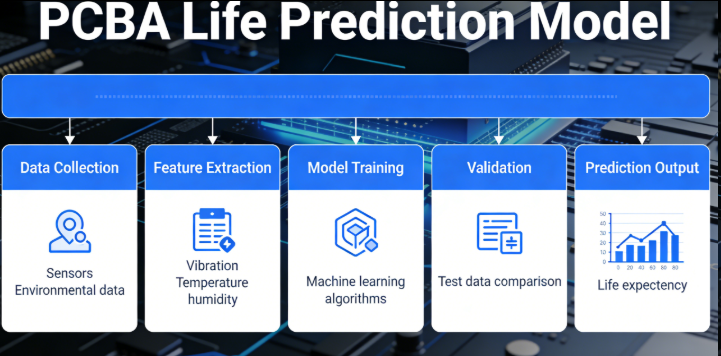
The life prediction model of Printed Circuit Board Assembly (PCBA) is a critical technical tool that enables manufacturers and end-users to estimate the service life of electronic assemblies, optimize product design, reduce maintenance costs, and ensure reliability in critical applications such as aerospace, automotive, and medical devices. At its core, the model integrates multiple disciplines, including material science, thermodynamics, mechanics, and statistical analysis, to quantify the impact of environmental stress, operational load, and manufacturing defects on PCBA degradation over time. The primary goal is to predict the time-to-failure (TTF) of PCBA components and the entire assembly, providing data-driven guidance for design improvement, maintenance scheduling, and risk mitigation.
Two dominant approaches are widely adopted in PCBA life prediction: the Physics of Failure (PoF) model and the statistical reliability model. The PoF model, which is increasingly favored for high-reliability applications, focuses on identifying the fundamental failure mechanisms of PCBA components—such as solder joint fatigue, dielectric breakdown, copper trace corrosion, and component aging—and establishing mathematical relationships between stress factors (e.g., temperature cycling, vibration, humidity, and electrical load) and material degradation. For example, solder joint fatigue, one of the most common failure modes, can be modeled using the Coffin-Manson equation, which correlates the number of thermal cycles to failure with the plastic strain amplitude induced by temperature fluctuations. This model requires detailed data on material properties, component geometry, and environmental conditions, often obtained through accelerated life testing (ALT) and finite element analysis (FEA) simulations.
The statistical reliability model, by contrast, relies on historical failure data and statistical methods (such as Weibull analysis, exponential distribution, and Bayesian updating) to predict PCBA life without explicitly identifying failure mechanisms. This approach is more practical for large-scale production and consumer electronics, where extensive failure data is available. For instance, Weibull analysis can be used to fit failure data and determine the characteristic life and shape parameter of PCBA, enabling the prediction of failure probability at a given time. In recent years, the integration of machine learning (ML) and Internet of Things (IoT) technologies has further advanced PCBA life prediction models. IoT sensors embedded in PCBA can real-time monitor operational parameters (temperature, vibration, voltage, current), while ML algorithms analyze this data to identify degradation trends, predict potential failures, and even optimize operational conditions to extend service life. These hybrid models combine the accuracy of PoF with the efficiency of statistical methods, making them suitable for complex and dynamic operating environments where stress factors are variable and unpredictable.




 Home >


