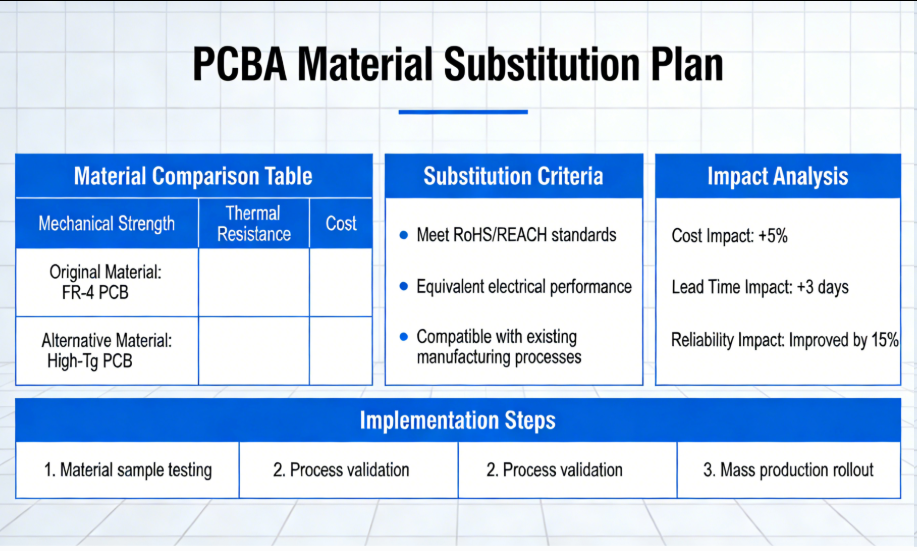
The formulation of a PCBA (Printed Circuit Board Assembly) material substitution plan is a critical process to ensure the continuity of production when the original specified materials are in short supply, discontinued, or fail to meet new requirements such as environmental protection or cost control. This plan must be developed with strict adherence to technical standards, quality requirements, and production feasibility to avoid potential risks to product performance, reliability, and safety. The first step in formulating the plan is to conduct a comprehensive analysis of the original material, including its electrical parameters (such as resistance, capacitance, voltage rating, and current capacity), physical characteristics (size, package type, thermal conductivity), and functional role in the PCBA. This analysis helps identify the core performance indicators that the alternative material must meet to ensure compatibility with the existing circuit design and assembly process.
Once the core requirements are clarified, the next step is to screen potential alternative materials from qualified suppliers. This screening process involves evaluating the alternative material’s specifications against the original material, verifying its compliance with industry standards (such as IPC, RoHS, and ISO), and assessing the supplier’s capability to provide stable and consistent quality. It is also essential to consider the cost difference between the original and alternative materials, as well as the lead time for procurement, to ensure that the substitution does not significantly increase production costs or cause production delays. After identifying suitable alternatives, a series of tests and validations must be conducted, including bench tests to verify electrical performance, environmental tests (temperature, humidity, vibration) to ensure reliability, and assembly tests to confirm compatibility with the SMT (Surface Mount Technology) process, such as solderability and placement accuracy.
Finally, the substitution plan should be documented in detail, including the original material information, alternative material specifications, test results, supplier information, and implementation schedule. It should also include a risk assessment and mitigation measures, such as potential issues that may arise during the transition period (e.g., production line adjustments, staff training) and contingency plans if the alternative material fails to meet expectations. The plan must be reviewed and approved by relevant departments, including engineering, quality control, procurement, and production, to ensure cross-departmental consensus and smooth implementation. Regular reviews and updates of the substitution plan are also necessary to adapt to changes in material supply, technology upgrades, and market demands.




 Home >


