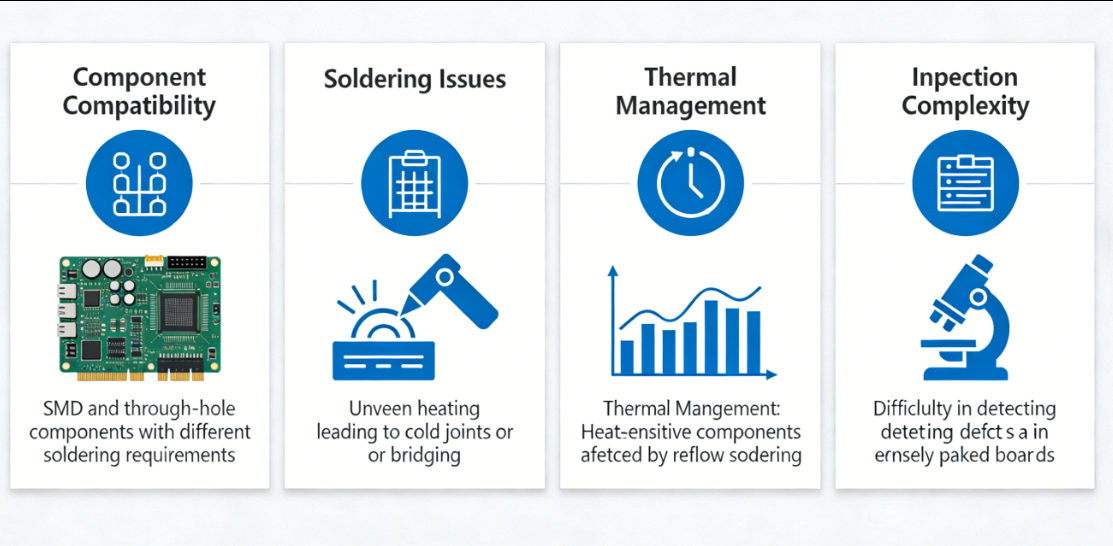
The mixed assembly process of PCBA (Printed Circuit Board Assembly) refers to the combination of through-hole technology (THT) and surface mount technology (SMT) in a single circuit board assembly, which is widely used in electronic products that require both high reliability and high integration. However, this process faces multiple technical difficulties that directly affect the quality, efficiency and cost of the final product. One of the core difficulties is the coordination between different assembly processes and the compatibility of components. SMT components are small in size, high in density, and require precise placement and reflow soldering, while THT components are usually larger, with pins inserted through the circuit board holes, requiring wave soldering or manual soldering. The difference in soldering temperature and time between the two processes often leads to problems such as poor soldering, component damage, or solder joint cracks. For example, reflow soldering temperatures for SMT components typically range from 220°C to 260°C, while wave soldering temperatures are around 260°C to 280°C; if the sequence of processes is not properly arranged, pre-soldered SMT components may be re-melted during wave soldering, resulting in component displacement or bridging.
Another major difficulty in mixed assembly is the control of solder paste and flux, as well as the management of component placement accuracy. SMT components, especially fine-pitch devices such as QFPs (Quad Flat Packages) and BGAs (Ball Grid Arrays), require uniform solder paste printing with accurate thickness and no bridging, which places high demands on the stencil design, solder paste viscosity, and printing parameters. In contrast, THT components require sufficient flux to ensure that the pins are fully wetted during soldering, but excessive flux may cause residue accumulation, affecting the electrical performance and reliability of the PCBA. Additionally, the mixed placement of SMT and THT components increases the complexity of the placement process: SMT components need to be placed first using automated placement machines, while THT components are often inserted manually or by semi-automated equipment, which is prone to human error and reduces production efficiency. Moreover, the difference in thermal expansion coefficients between different components and the PCB substrate may lead to thermal stress during the soldering process, resulting in solder joint fatigue or PCB warpage, which is particularly prominent in mixed assembly where components of different sizes and materials coexist.
Furthermore, quality inspection and defect repair are more challenging in mixed assembly processes. The high density of SMT components and the overlapping of THT component pins make it difficult to detect defects such as cold solder joints, dry solder joints, and bridging using traditional visual inspection methods. Advanced inspection equipment such as AOI (Automated Optical Inspection) and X-ray inspection are required, which increases equipment investment costs. At the same time, repairing defects in mixed assembly is more complex: repairing a faulty SMT component may require reflow soldering, which may affect adjacent components, while repairing a THT component may require desoldering the pins, which risks damaging the PCB pads. These difficulties require strict process control, advanced equipment, and skilled operators to ensure the stability and reliability of the PCBA mixed assembly process.




 Home >


