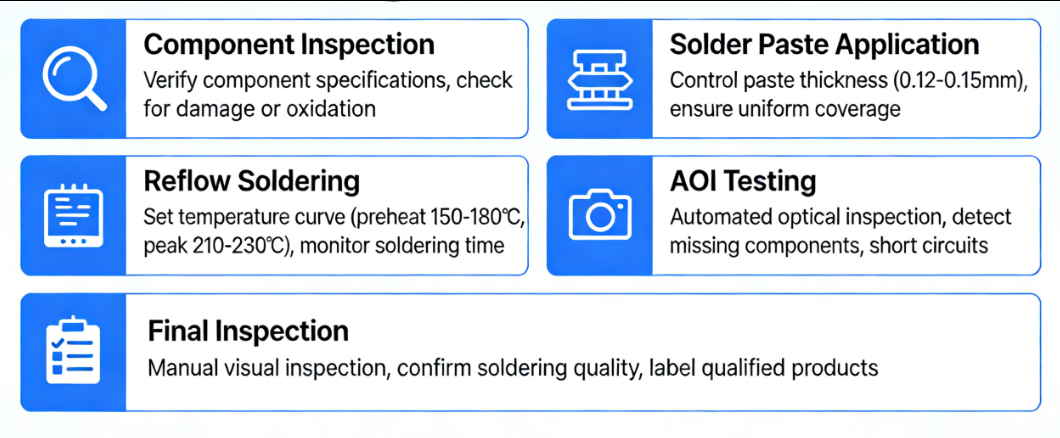
PCBA (Printed Circuit Board Assembly) production quality management is a systematic process that runs through the entire manufacturing cycle, from component incoming inspection to final product testing, aiming to minimize defects, ensure product reliability, and meet customer requirements. The core of quality management lies in prevention rather than correction, which requires establishing strict control standards, implementing real-time monitoring, and continuously optimizing processes. Incoming material quality control is the first line of defense; all components, including resistors, capacitors, integrated circuits, and connectors, must undergo rigorous inspection to verify their specifications, authenticity, and performance. This involves visual inspection for physical damage, soldering compatibility checks, and electrical performance testing using specialized equipment such as multimeters and component testers. Any non-conforming materials should be promptly isolated and handled to avoid entering the production line, which can significantly reduce subsequent rework and waste.
In the assembly process, process control is crucial to ensuring consistent quality. Key links include solder paste printing, component placement, reflow soldering, and wave soldering. For solder paste printing, parameters such as stencil thickness, printing speed, and pressure must be precisely calibrated and regularly checked to ensure uniform solder paste deposition, which directly affects the quality of solder joints. Component placement requires high-precision SMT (Surface Mount Technology) machines, and operators must verify the accuracy of component orientation and placement coordinates to prevent misplacement or reverse installation. Reflow soldering and wave soldering processes need strict temperature profile control; the heating and cooling rates must comply with the requirements of different components to avoid issues such as cold solder joints, bridging, or component damage due to overheating. Additionally, in-process inspection (IPQC) should be conducted at each key station, with inspectors using microscopes to check solder joint quality, component integrity, and any potential defects in real time.
Final quality testing and continuous improvement are also essential components of PCBA production quality management. Final inspection includes visual inspection, electrical testing (such as in-circuit testing ICT and functional testing FCT), and reliability testing (such as temperature cycling and vibration testing) to ensure that the finished PCBA meets all electrical and mechanical specifications. Any defective products identified should be analyzed to determine the root cause, whether it is due to material issues, process errors, or equipment malfunctions, and corrective and preventive actions should be implemented to avoid recurrence. Moreover, establishing a quality management system (QMS) compliant with ISO 9001 or IATF 16949 standards can provide a systematic framework for quality control, including documentation of processes, employee training, and regular audits. By integrating these measures, enterprises can effectively improve PCBA production quality, enhance customer satisfaction, and gain a competitive advantage in the market.




 Home >


