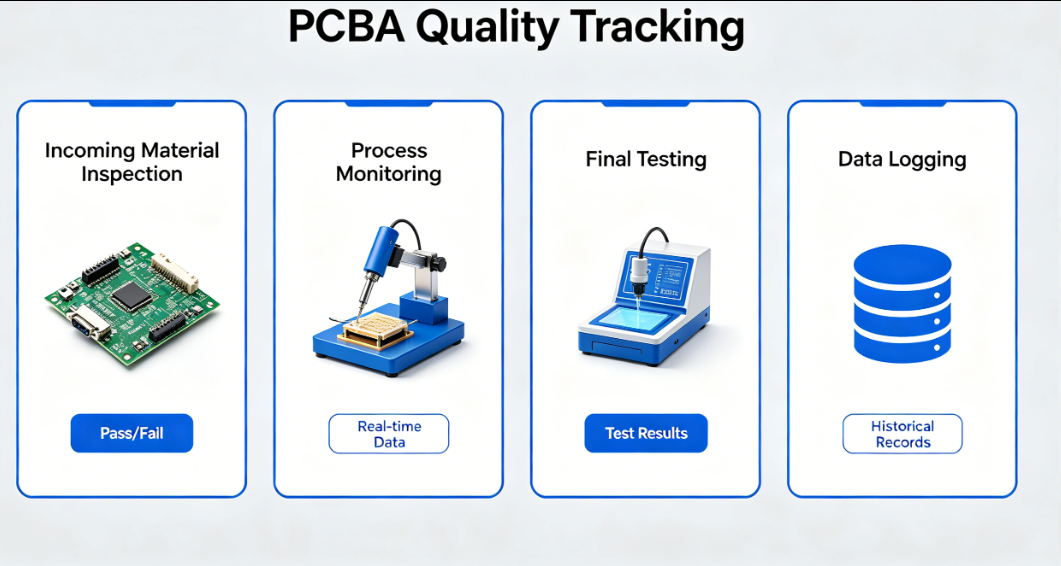
PCBA quality tracking is a comprehensive management system that covers the entire lifecycle of PCBA, from raw material procurement and production process to testing, delivery, and after-sales service, aiming to achieve full-process traceability of product quality, identify potential risks in a timely manner, and continuously improve product reliability. With the increasing complexity of electronic products and the strict requirements for quality in industries such as automotive and medical, an effective quality tracking system has become an essential part of PCBA manufacturing, ensuring transparency and controllability of the production process.
The core of PCBA quality tracking lies in the establishment of a digital traceability system, which relies on manufacturing execution systems (MES) and centralized databases to collect and record key data throughout the production process. In the supply chain link, each batch of components is assigned a unique code, enabling traceability to the production batch, supplier qualification, and logistics information, effectively avoiding risks such as counterfeit materials and obsolete materials. In the production process, real-time data collection covers SMT placement (placement pressure, temperature curve, solder paste dosage), DIP insertion, and welding processes, with X-Ray detection used to record BGA solder joint void rate, and all data linked to the work order system to ensure process consistency.
Quality tracking also includes the establishment of a visual quality file for each PCBA product, usually in the form of a unique QR code or barcode. Through a dedicated query port, relevant personnel can access detailed information such as component batch numbers, supplier details, production equipment numbers, operator information, quality inspection records, and test results (ICT/FCT pass rate, aging test data). This not only facilitates quick tracing of defective products but also provides data support for root cause analysis when quality issues occur, such as identifying whether the problem is caused by raw materials, process parameters, or operator errors.
To ensure the effectiveness of quality tracking, it is necessary to combine multi-dimensional detection mechanisms and data-driven continuous improvement. The detection system includes incoming inspection (component specification verification, X-Ray scanning), in-process inspection (AOI for solder joint defects, SPI for solder paste analysis), and final inspection (FCT simulation of actual working conditions, high and low temperature cycle tests). Statistical Process Control (SPC) is used to analyze yield fluctuations, establish Process Capability Index (CPK) models, and reduce key process defect rates. Regular quality reports are generated to summarize problems and put forward improvement measures, forming a closed-loop management of quality tracking. This full-lifecycle quality tracking system not only reduces quality risks and maintenance costs but also enhances market trust in PCBA products.




 Home >


