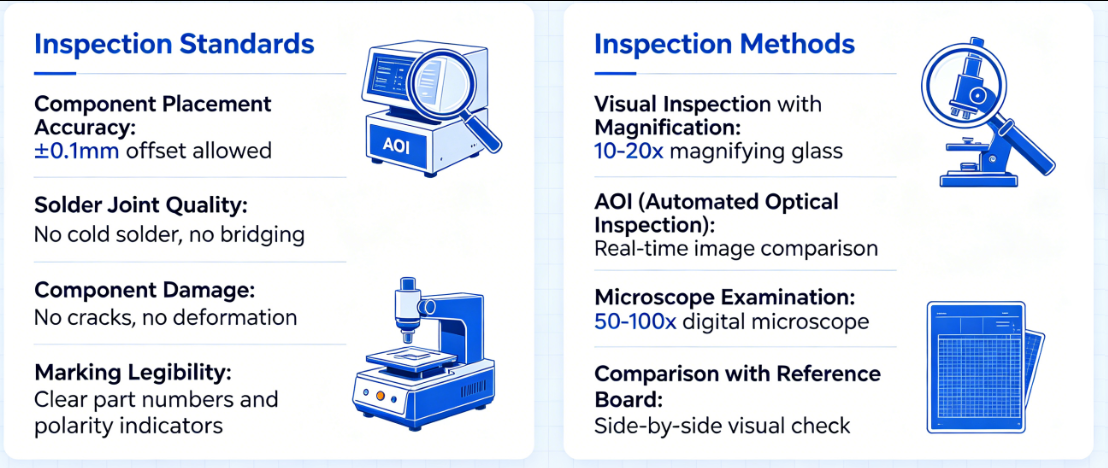
PCBA visual inspection is a fundamental quality control process that involves examining the printed circuit board assembly for physical defects, manufacturing errors, and non-conformities using visual or magnified observation. This inspection is performed at various stages of the manufacturing process, including after solder paste application, component placement, reflow soldering, wave soldering, and final assembly. Visual inspection is critical for identifying defects that can affect the PCBA’s functionality, reliability, and performance, such as solder joint defects, component misplacement, damage to components or traces, and contamination. The standards and methods for PCBA visual inspection are defined by industry organizations and manufacturers to ensure consistency and accuracy.
The main standards governing PCBA visual inspection include IPC-A-610 (Acceptability of Electronic Assemblies), which is the most widely used standard in the electronics industry. IPC-A-610 defines the acceptability criteria for various types of defects, including solder joints, component placement, lead bending, conformal coating, and cleanliness. The standard categorizes defects into three classes: Class 1 (general electronic products, low reliability requirements), Class 2 (dedicated service electronic products, moderate reliability requirements), and Class 3 (high-reliability electronic products, such as aerospace, medical, and military applications, with strict reliability requirements). Each class has different acceptability criteria, with Class 3 being the most stringent.
The methods of PCBA visual inspection include manual visual inspection, automated optical inspection (AOI), and x-ray inspection. Manual visual inspection is the most basic method, involving the use of the naked eye or a magnifying glass (typically 10-20x magnification) to examine the PCBA. This method is suitable for small-volume production or for inspecting defects that are easily visible, such as component misplacement, missing components, or obvious solder joint defects. However, manual inspection is prone to human error and is less efficient for large-volume production or for detecting small, subtle defects.
Automated Optical Inspection (AOI) is a more advanced method that uses high-resolution cameras and image processing software to automatically inspect the PCBA. AOI systems can detect a wide range of defects, including solder joint defects (e.g., bridging, cold solder, insufficient solder), component misplacement (e.g., offset, rotation, wrong component), missing components, damaged components, and trace damage. AOI is fast, accurate, and consistent, making it suitable for large-volume production. The system compares the images of the tested PCBA with a reference image (of a good PCBA) and flags any deviations as defects. AOI can be integrated into the manufacturing line to provide real-time feedback, allowing for immediate correction of manufacturing errors.
X-ray inspection is used to inspect defects that are not visible from the surface of the PCBA, such as solder joints under BGA (Ball Grid Array) packages, QFN (Quad Flat No-lead) components, or other hidden components. X-ray inspection uses X-ray radiation to penetrate the PCBA and create a cross-sectional image of the internal structure, allowing inspectors to evaluate the quality of hidden solder joints (e.g., voids, insufficient solder, bridging). This method is critical for high-reliability PCBs, as hidden defects can lead to premature failure. X-ray inspection can be manual (using a benchtop X-ray system) or automated (integrated into the manufacturing line).
The visual inspection process typically involves the following steps: preparation (cleaning the PCBA to remove flux residue or contamination), inspection (using the selected method to examine the PCBA), documentation (recording any defects found, including their location, type, and severity), and disposition (determining whether the PCBA is acceptable, needs rework, or should be scrapped). The inspection criteria are based on the applicable standard (e.g., IPC-A-610) and the specific requirements of the product. It is important to train inspectors properly to ensure that they can accurately identify defects and apply the correct acceptability criteria. Visual inspection is a cost-effective and essential quality control step that helps ensure the reliability and performance of PCBs.




 Home >


