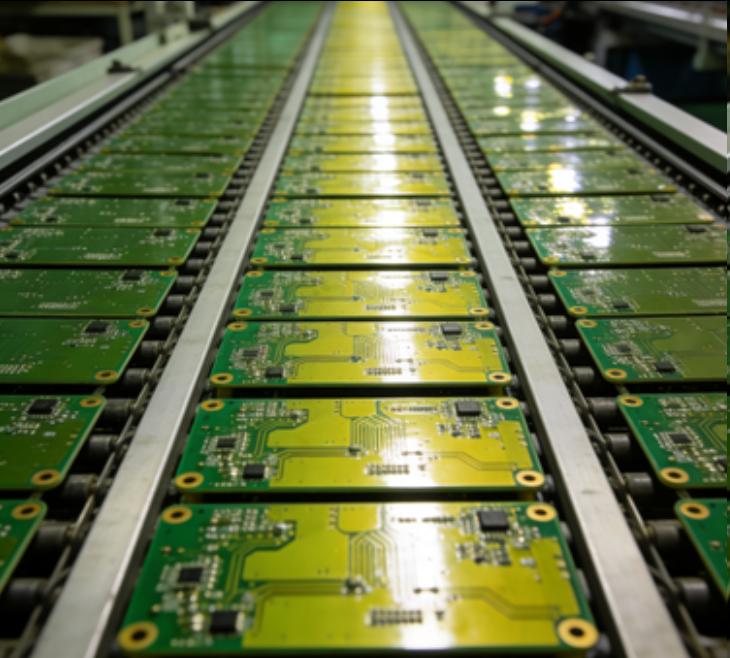
Printed Circuit Boards (PCBs) with Organic Solderability Preservatives
(OSP) surface finish have gained significant popularity in the electronics
manufacturing industry due to their unique properties and advantages. OSP is a
thin, transparent organic coating applied to the copper surfaces of PCBs,
primarily serving to protect the copper from oxidation and enhance its
solderability during the assembly process.
The OSP coating is typically applied through a chemical immersion process.
First, the PCB undergoes a thorough cleaning to remove any contaminants, such as
oils, dirt, or oxides, from the copper surface. This cleaning step is crucial as
any impurities can interfere with the adhesion and performance of the OSP
coating. After cleaning, the PCB is immersed in a bath containing the OSP
solution. The solution reacts with the copper surface, forming a very thin,
molecular - level organic film. This film acts as a barrier, preventing oxygen
and moisture from reaching the copper and thus inhibiting oxidation.
One of the key benefits of OSP surface finish is its ultra - thin nature.
Compared to other surface finishing methods like electroless nickel - immersion
gold (ENIG) or hot - air solder leveling (HASL), OSP coatings are much thinner,
usually in the range of 0.2 - 0.5 micrometers. This thinness allows for better
compatibility with fine - pitch components, enabling more precise soldering and
reducing the risk of solder bridging between closely - spaced pads. In high -
density PCBs where component sizes are getting smaller and pad pitches are
becoming finer, the use of OSP can significantly improve the assembly yield and
overall reliability of the PCB.
Another advantage of OSP is its cost - effectiveness. The application
process of OSP is relatively simple and requires less equipment and chemicals
compared to more complex surface finishing techniques. Additionally, since OSP
coatings are thin, they consume fewer materials, further reducing production
costs. This makes PCBs with OSP surface finish an attractive option for mass -
production applications where cost control is a critical factor.
However, PCBs with OSP surface finish also have some limitations. The OSP
coating is relatively fragile and can be easily damaged during handling or
storage if not properly protected. It has a limited shelf life, and exposure to
high humidity or long - term storage can degrade the coating's performance,
reducing its solderability. To mitigate these issues, proper handling
procedures, such as using anti - static packaging and storing PCBs in a
controlled - humidity environment, are essential. Despite these limitations, the
benefits of OSP surface finish, including its thinness, cost - effectiveness,
and good solderability, make it a widely used choice for many electronics
applications, especially in consumer electronics and high - density circuit
board designs.




 Home >


