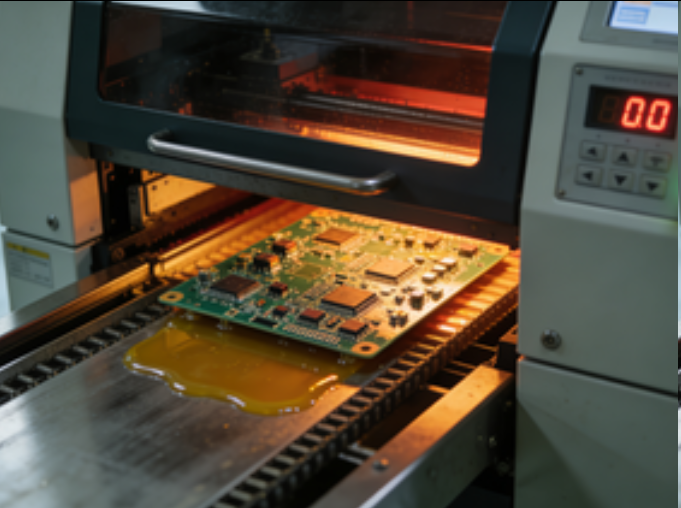
SMT (Surface Mount Technology) PCBA assembly is a widely used electronic
manufacturing process that mounts surface-mount components (SMDs) directly onto
the surface of printed circuit boards (PCBs), replacing traditional through-hole
technology for compact, high-density electronic products. This process is
critical for manufacturing smartphones, laptops, IoT devices, and automotive
electronics, where miniaturization and high production efficiency are
essential.
The SMT assembly process consists of four core stages, each requiring
precision equipment and strict quality control. First, solder paste printing
uses a stainless-steel stencil with laser-cut apertures to apply a uniform layer
of solder paste (a mixture of tin-lead or lead-free alloy particles and flux)
onto the PCB’s solder pads. The stencil’s aperture size and thickness are
tailored to component size—for example, 0402 chip resistors require 0.2mm×0.1mm
apertures to ensure accurate paste deposition. Advanced printers (e.g., Fuji NXT
III) integrate 3D solder paste inspection (SPI) to verify paste volume and
shape, reducing defects caused by insufficient or excessive paste.
Second, component placement relies on high-speed pick-and-place machines
equipped with vision systems. These machines (such as Yamaha YSM40R) can place
up to 40,000 components per hour, including microchips (e.g., QFP, BGA, and
01005 ultra-miniature components). The vision system aligns components with PCB
pads using fiducial marks, ensuring placement accuracy within ±0.02mm. For BGA
components, special nozzles apply controlled pressure to prevent solder ball
damage.
Third, reflow soldering heats the PCB in a temperature-controlled oven
(typically 8–10 zones) to melt the solder paste. The oven’s temperature profile
is optimized for the solder alloy—lead-free solder (e.g., Sn96.5Ag3.0Cu0.5)
requires a peak temperature of 245–255°C, while leaded solder peaks at
215–225°C. This stage forms permanent electrical and mechanical bonds between
components and the PCB.
Finally, inspection and testing use automated optical inspection (AOI)
systems (e.g., Omron VT-S720) to detect defects like missing components, solder
bridges, or tombstoning. For high-reliability applications (e.g., medical
devices), X-ray inspection is used to check hidden solder joints (e.g., BGA
underfill).
SMT assembly offers key advantages: it enables smaller PCB sizes
(components occupy 60–70% less space than through-hole parts), higher production
efficiency, and better electrical performance at high frequencies. However, it
requires precise process control—even minor variations in solder paste viscosity
or reflow temperature can cause defects.




 Home >


