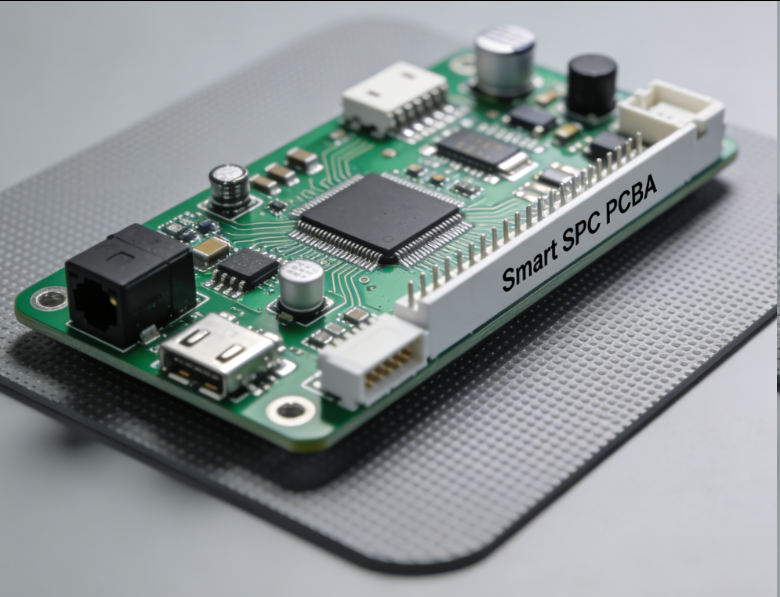
As the core hardware of smart speakers, the PCBA (Printed Circuit Board Assembly) integrates multiple functional modules to realize voice interaction, wireless connection and high-quality audio output. It is a highly integrated system that faces the dual challenges of multi-system collaboration and high integration, with core requirements focusing on the balance of signal integrity, electromagnetic compatibility (EMC) and thermal management. The main control chip on the PCBA is responsible for real-time voice processing and multi-protocol communication, supporting Wi-Fi 6 and Bluetooth 5.3, which has strict requirements on power stability and clock accuracy.
Most mainstream smart speaker PCBs adopt a 6-layer design (Signal-GND-Signal-Power-GND-Signal) to effectively isolate digital and analog signals, reducing noise interference. The microphone array uses a differential input structure, and impedance matching and crosstalk control must be strictly implemented during wiring to avoid introducing background noise. In addition, the PCBA is equipped with a power management module, an audio power amplifier and a signal conversion chip, which ensure stable power supply, clear audio output and efficient signal transmission respectively. With the popularization of far-field voice wake-up technology, the PCBA design also focuses on optimizing the sensitivity of the microphone array, enabling the smart speaker to accurately recognize voice commands within 7 meters, and it can also be connected with smart home devices to realize intelligent control functions such as curtain opening and temperature adjustment.




 Home >


