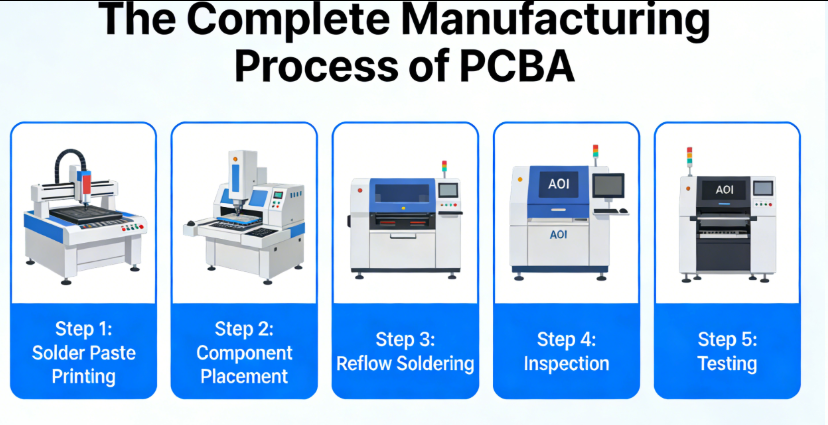
The complete manufacturing process of PCBA (Printed Circuit Board Assembly) is a systematic and precise sequence of steps that transforms raw materials into a functional electronic assembly, involving multiple stages of production, inspection, and testing to ensure quality and reliability. The process begins with PCB fabrication, which is the foundation of PCBA. First, the PCB design file (usually in Gerber format) is imported into manufacturing equipment, and the copper-clad laminate is cut to the required size. Then, through processes such as drilling, electroplating, etching, solder mask printing, and silkscreen printing, the circuit patterns, holes, and identification marks are formed on the PCB. This stage requires strict control of parameters such as hole precision, copper thickness, and solder mask uniformity to ensure that the PCB can effectively support component mounting and signal transmission.
After the PCB is fabricated, the assembly process officially starts, which is divided into two main parts: surface mount technology (SMT) and through-hole technology (THT). In the SMT stage, solder paste is printed on the PCB pads using a stencil, ensuring uniform thickness and accurate positioning. Then, surface mount components (SMDs) such as resistors, capacitors, and integrated circuits are placed on the solder paste by a pick-and-place machine with high precision. The PCB with components is then sent to a reflow oven, where the solder paste melts at a specific temperature curve to form a reliable solder joint between the components and the PCB. After SMT, the THT stage follows for components that cannot be surface-mounted, such as connectors and power devices. These components are inserted into the through-holes of the PCB, and then soldered using wave soldering or manual soldering to fix them firmly. Finally, the assembled PCBA undergoes a series of inspections and tests, including visual inspection (VI), automated optical inspection (AOI), in-circuit test (ICT), and functional test (FT), to detect defects such as missing components, wrong components, poor solder joints, and functional failures. Only after passing all tests can the PCBA be delivered for subsequent use.




 Home >


