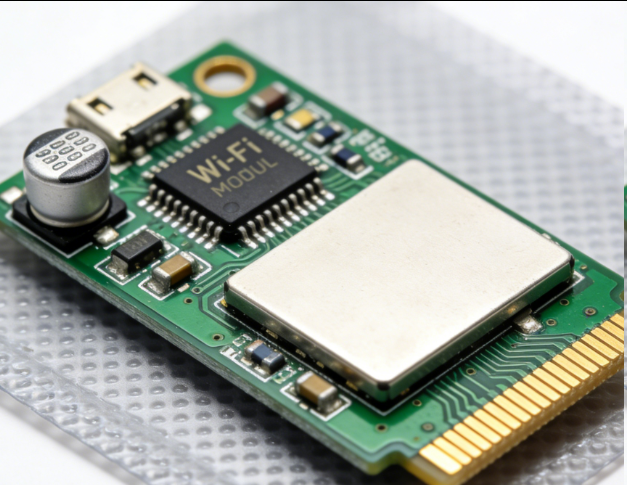
The Wi-Fi Module PCBA is a core integrated circuit assembly designed for wireless local area network connectivity, enabling devices to access and transmit data over Wi-Fi protocols such as 802.11a/b/g/n/ac/ax. It integrates key components including a Wi-Fi chip, power management unit (PMU), RF front-end, antenna interface, and peripheral interfaces (such as UART, SPI, I2C) on a printed circuit board, ensuring stable and efficient wireless communication. The design of this PCBA emphasizes signal integrity and electromagnetic compatibility (EMC) to minimize interference from external signals and internal components, thereby improving the reliability of data transmission.
One of the key advantages of the Wi-Fi Module PCBA is its high degree of integration and flexibility, which allows for easy integration into a wide range of electronic devices without the need for complex independent Wi-Fi circuit design. It supports various operating modes, including station mode (connecting to a router), soft AP mode (acting as a wireless hotspot), and Wi-Fi Direct mode (direct device-to-device communication), adapting to different application scenarios. Additionally, advanced power management technologies are adopted to optimize power consumption, making it suitable for battery-powered devices such as portable IoT sensors and smart wearables.
This PCBA is widely applied in the Internet of Things (IoT) ecosystem, smart home devices (such as smart bulbs, thermostats, and security cameras), industrial automation systems, and consumer electronics (such as tablets and laptops). In smart home scenarios, it enables users to remotely control devices via smartphones; in industrial settings, it facilitates real-time data transmission between sensors and control centers, enhancing operational efficiency. With the continuous development of Wi-Fi 6 and Wi-Fi 7 technologies, modern Wi-Fi Module PCBA also supports higher data transfer rates, lower latency, and better multi-device connectivity, meeting the growing demand for high-performance wireless communication.




 Home >


